
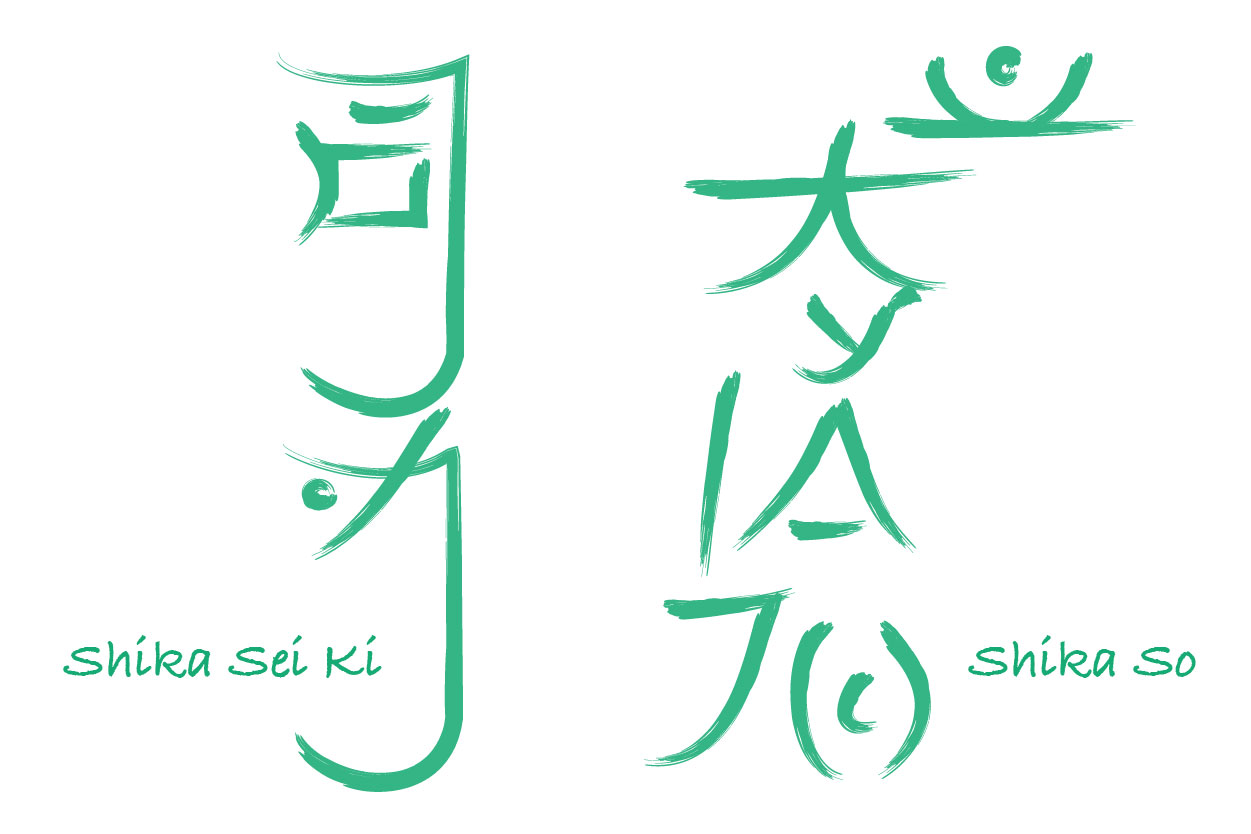
Symbols have always fascinated us.
Since the dawn of civilization, they have been part of culture, beliefs, and spiritual practices. From helping our infrastructure to religious institutions, symbols are present everywhere.
They help us bridge the spiritual with the physical world and enhance our daily living with divine wisdom.
In Reiki, there are two categories of symbols.
Traditional – passed down from Mikao Usui.
Non-traditional – channeled by other Reiki Masters.
The symbols in the second category act as an enhancement for passing on attunements or supporting the body’s natural healing ability in specific situations.
While not all Reiki schools or teachers agree with this approach, the usefulness of these symbols is undeniable.
Such is the case with the Shika Sei Ki and Shika So symbols.
What are the Shika So & Shika Sei Ki Reiki symbols and where do they come from?
These two symbols come through the following lineage:
Hayato Takata – Iris Ishikuro – Arthur Roberston
It is unclear which of the 3 has channeled them, but these symbols were implemented at Usui Reiki Level II by only a few teachers who were descendants of this lineage.
While they still resemble the Japanese Kanji format, they are considered non-traditional.
Still, their effectiveness is embraced by many practitioners.
One helps heal emotional imbalances.
The other ensures harmonious communication.
Let’s take them one by one.
Shika Sei Ki
This symbol is similar to Sei Hei Ki.
While Sei He Ki has many other uses, Shika Sei Ki focuses solely on the heart, as an organ, the heart chakra, and the thymus gland.
Shika Sei Ki can help:
- Retrieve lost fragments of the soul and heal it structure.
- Dissolve the negative energy behind grief or depression.
- Balance tachycardia and oscillating tension.
Shika Sei Ki enables the practitioner to access the necessary vibration within the universal life force energy spectrum connected to forgiveness, compassion, and understanding.
Use it in self-treatment to integrate these values for your emotional well-being.
Shika So
This symbol enhances communication.
Once you tackle the emotional layer, expressing yourself harmoniously is the next step.
Communication isn’t limited to verbal speech.
There are many ways to express yourself like thoughts, feelings, and emotions. Writing, singing, painting, or any creative-related feat is a form of expression.
Shika So can help:
- Remove stage fright by promoting harmonious verbal communication.
- Stimulate the throat chakra and provide ways to express yourself authentically.
- Regulate thyroid-related imbalances.
Shika So promotes the expressiveness of inner emotions and feelings. It can also facilitate healthy communication for couples or groups of people.
Through this symbol, you can benefit from a healthy understanding of your inner self that permeates into your life.
Using Shika Sei Ki and Shika with other Reiki symbols.
Shika Sei Ki and Shika So will enhance the effects of other symbols.
Help heal the soul and heart:
- Activate them on your palms and then on your heart chakra.
- Hold your palms in this area for 10 minutes daily.
- Notice how your mood improves day after day.
- Add Harth form Karuna Reiki to enhance the universal energy flow as well as the entire healing effect.
Help heal and release deep emotions, thoughts, and ideas:
- Activate Shika So + Zonar on the throat chakra.
- Place your palms and hold them above this energy center for about 10 minutes.
- Allow the universal energy and the specific manifestation of this sequence of Reiki symbols to release any stagnant emotions. Gradually, this exercise will help you express yourself at the right time.
Cleanse a room and promote healthy communication:
- Activate Cho Ku Rei + Sei He Ki + Shika Sei Ki + Shika So in the center of the room dissolve any stagnant energy and infuse the space with pure love and compassion.
These symbols work best when you give them time to settle.
Don’t rush the process or expect immediate transformation.
The heart and throat chakras hold years of unexpressed emotion and guarded communication. They won’t release everything in one session.
Instead, approach this work with patience.
Use the sequences above consistently, even when you don’t feel dramatic shifts. The changes often show up quietly in how you respond to conflict, in conversations that flow easier, or in the tension that slowly dissolves from your chest.
That’s the nature of emotional healing.
It doesn’t announce itself loudly.
It gradually becomes the baseline.
The most useful symbols are often the least talked about.
Shika Sei Ki and Shika So didn’t spread through mainstream Reiki training because they came from a lineage only a handful of teachers followed closely enough to preserve. Their absence from most curricula has nothing to do with their effectiveness.
That gap matters because practitioners working with grief, communication blocks, or heart-level imbalances are solving for exactly what these symbols address.
Used with patience, these two symbols close a loop that standard practice leaves open. The heart heals, the throat speaks, and the emotional body finds a way to move forward rather than circle the same pain.
Some of the best tools are still waiting to be found.